
A medicine older than memory
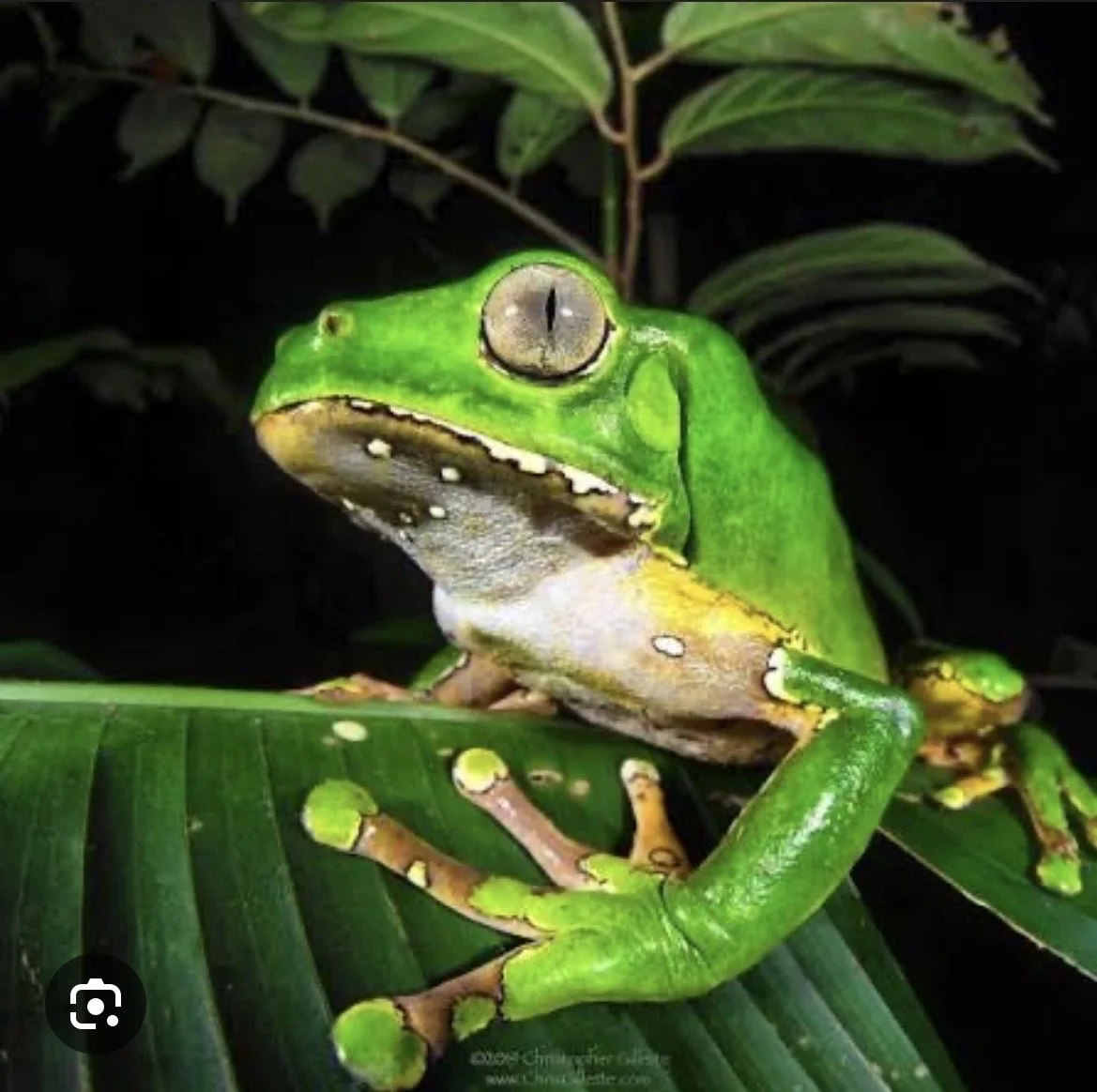
Kambo is the secretion of the giant monkey frog, Phyllomedusa bicolor, who sings through the canopy of the western Amazon. For countless generations — long before any laboratory existed — the indigenous peoples of the rainforest have known this frog as a teacher and a healer. To them it is not a chemical. It is a relative, a spirit, a gift of the forest.
Among the Matsés (sometimes called the Mayoruna), Kambo is sacred. Hunters receive the medicine to sharpen the senses, steady the hands, build stamina, and clear what they call "panema" — the heavy, stagnant, unlucky energy that clouds a person and keeps the forest from offering itself. After Kambo, the hunter is said to move through the jungle clean, alert, and unseen. This is a living tradition, never written down, passed hand to hand and heart to heart across time.
The frog, gathered with respect
The tradition is built on reciprocity. The frog is found by its song, gently held, and never harmed; a small amount of its secretion is collected, and the frog is returned to the forest to continue its life. The medicine is dried onto a stick and kept until it is needed.
To give Kambo, a practitioner makes a few small points on the surface of the skin and applies the secretion directly. What follows is brief and intense — a wave of heat, a quickening of the heart, and a deep purge that the tradition understands as the body and spirit releasing what no longer serves. Within minutes it passes, and a clarity settles in. Kambo has always been given by trained hands, with great care for the person receiving it.
Honoring the lineage
The Matsés are not alone. The Katukina, Yawanawá, Kaxinawá (Huni Kuin), Marubo, and other peoples of Brazil and Peru carry their own frog-medicine traditions, each with its own songs, protocols, and understanding. As Kambo travels out of the Amazon and into the wider world, honoring these origins — and the peoples who have protected this knowledge — matters more than ever. We hold this medicine with gratitude to those who kept it alive.
The science: a living pharmacy
Western science has only recently begun to catch up to what the forest has long known. Here is something important to understand: there is still very little formal research on whole Kambo as a medicine. What there is a great deal of research on are the individual peptides the secretion contains — and that body of work is remarkable. The frog's skin is, quite literally, a living pharmacy: a single dose can contain dozens of bioactive compounds that act on the gut, the blood vessels, the stress system, the immune system, and the brain's own opioid pathways. Here is what researchers have learned about the major peptides, studied one by one.
Phyllocaerulein (caerulein). A close cousin of a hormone our own bodies make, cholecystokinin, this peptide acts on CCK receptors to stimulate digestion and the gallbladder. In its pharmaceutical form, caerulein (ceruletide) has actually been used in medicine to aid digestion and as a diagnostic agent. It also lowers blood pressure and has shown pain-relieving and sedating effects in studies — part of why Kambo produces such a strong gastrointestinal response.
Phyllomedusin. A member of the tachykinin family, related to the body's own substance P, phyllomedusin acts powerfully on the smooth muscle of the gut through NK1 receptors. Research links this peptide to the intense purging and emptying the tradition prizes as cleansing, along with increased secretions and effects on the blood vessels.
Phyllokinin. A bradykinin-related peptide and one of the most potent vasodilators known — it widens blood vessels and increases their permeability. Studies attribute much of Kambo's rush of heat, flushing, and temporary drop in blood pressure to this peptide. It can also influence the blood–brain barrier, which may help other compounds reach the nervous system.
Sauvagine. This peptide mirrors corticotropin-releasing factor (CRF), the molecule that switches on the body's stress-and-adrenal axis. Through CRF receptors it influences the release of stress hormones, blood pressure, and mood, and has been studied for its effects on the stress response and the gut.
Dermorphin. One of the most extraordinary discoveries from this frog. Dermorphin is a natural opioid peptide that binds the body's μ-opioid receptors with remarkable strength — in laboratory studies many times more potent than morphine for pain relief. It was first identified in Phyllomedusa skin in 1981 and has been studied for analgesia ever since.
Deltorphin. Discovered in the same frog family around 1990, the deltorphins remain the most potent and selective δ-opioid agonists science has found anywhere in nature. Researchers study them for pain relief with the hope of fewer of the downsides of conventional opioids, and they may contribute to the resistance to fatigue, hunger, and thirst that the hunters describe.
Dermaseptins and adenoregulin. The secretion is also rich in dermaseptins — a family of antimicrobial peptides shown in research to fight bacteria, fungi, parasites, and even some viruses, and now being explored for anticancer potential. A related peptide, adenoregulin, acts on adenosine receptors. Strikingly, scientists found that the genetic blueprints for these antimicrobial peptides and for the opioid peptides above are closely related — the same frog evolved both its defense and its medicine from a shared origin.
What the science means
Taken together, this is one of the richest peptide pharmacies ever found in a single living creature — a reason researchers around the world continue to study Phyllomedusa bicolor for pain, inflammation, infection, and more. It is worth being honest, too: most of this work is still early, much of it done on isolated peptides in the lab rather than on whole Kambo in people, and Kambo is a powerful medicine that the tradition has always entrusted to trained, experienced hands. We share the science not to make medical claims, but out of awe — because the ancestors understood the gift of this frog long before anyone could measure why.
Research & further reading
Dermaseptins, multifunctional antimicrobial peptides: a review
For facilitation, visit Temple of Higher Frequency.